TU-BRIDGE Doctoral School: 13 Open Doctoral Candidate Positions
Overview
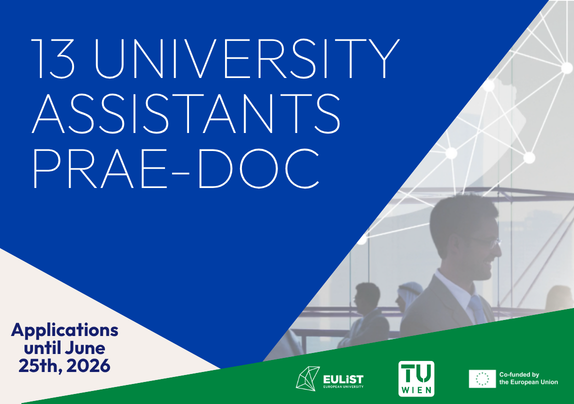
We announce 13 open positions as Doctoral Candidates (Pre-Doc) within the TU Austria Doctoral School “TU-BRIDGE” — the TU Austria Doctoral School for Battery Imaging, Durability, Aging & Recycling.
The positions are expected to start in October 2026. An earlier or later start may be possible, depending on the individual Doctoral Project.
TU-BRIDGE is a new research and doctoral training format bringing together researchers from:
- TU Graz
- TU Wien
- Montanuniversität Leoben
The doctoral school aims to shape the future of battery research in Austria by combining cutting-edge research projects with a jointly developed doctoral training framework.
The program includes 13 Doctoral Projects, with one doctoral candidate assigned to each project. The projects run within a structured, collaborative, and internationally competitive training program over a period of up to four years.
Research Focus
TU-BRIDGE addresses key challenges across the battery value chain, from improving battery lifetime to developing sustainable recycling methods.
The doctoral school focuses on three key themes:
Digital Twins
Using advanced models to simulate battery behavior, enabling better design, safer operation, and more efficient manufacturing and recycling.
Defects & Aging
Investigating how defects form and how batteries degrade over time, with the aim of improving safety, reliability, and performance.
Recycling Technology
Developing eco-friendly, chemistry-agnostic methods to recover valuable materials from batteries at the end of their lifetime.
Employment Conditions
Positions at TU Wien
- 40 hours per week
- Fixed-term contract for 3 years
- Possible extension to a maximum of 4 years, depending on the project
- Details are provided in the individual project descriptions
Positions at TU Graz and Montanuniversität Leoben
- 40 hours per week
- Fixed-term contract for 4 years
Each Doctoral Project will be led by a supervisory team of three professors from the relevant disciplines and institutions.
Further details on TU-BRIDGE, the place of employment, contract duration, and the individual Doctoral Projects are available in the project descriptions.
Tasks
Doctoral candidates will be expected to:
- Deepen scientific knowledge and conduct independent research on one of the Doctoral Projects
- Present research results at international conferences and scientific events
- Complete key milestones within the TU Austria Doctoral School program
- Participate in scientific events and outreach activities organized by TU Austria and the host university
- Prepare publications that form the basis of the doctoral thesis
- Participate in organizational and administrative tasks of the doctoral college
- Take part in secondments at partner organizations, ranging from short visits to multi-month stays in Austria
- Engage in teaching, student supervision, and exams
Candidate Profile
Applicants should have:
- A diploma or master’s degree in chemical engineering, process engineering, chemistry, physics, mechanical engineering, metallurgy, materials science, or a related discipline
- Experience in research fields relevant to the selected Doctoral Project
- Excellent communication and writing skills in English
- A strong interest in scientific collaboration
- Teamwork and problem-solving skills
- A positive attitude and willingness to contribute to the work environment
- Motivation for continuous personal development
- Willingness to complete doctoral studies at one of the three TU Austria universities
- German language proficiency at B2 level is preferred
- Willingness to develop sufficient German skills to participate actively in the academic environment
Additional admission requirements and essential qualifications depend on the specific Doctoral Project.
We Offer
The program offers:
- Diverse and exciting research projects on cutting-edge topics in battery research
- Continuing personal and professional education, including Career Development Plans
- High-quality supervision by renowned scientists
- Access to world-class infrastructure, including the X-Ray Center at TU Wien and pilot plants of project partners
- Opportunities to build an international research network
- Possibilities for secondments and research collaborations
- Courses on soft skills, including ethics, writing, and intellectual property rights
- Competitive salary and travel budget
- Social benefits, including health insurance
- Administrative support for study-related and organizational questions
- Excellent locations near the city centers of Vienna, Leoben, or Graz, depending on the Doctoral Project
Details of the benefits may vary depending on the host university.
Salary
The entry-level salary is determined by pay grade B1 of the Austrian collective agreement for university staff.
The minimum salary is currently:
EUR 3,776.10 gross per month, paid 14 times per year, for 40 hours per week.
Qualifications and experience may increase the monthly income.
Application Deadline
Applications must be submitted by:
25 June 2026
Recruitment Process
The TU-BRIDGE consortium is committed to gender equality, equal opportunities, and diversity in recruitment, teaching, and outreach.
TU-BRIDGE aims to increase the proportion of women in research. Qualified female applicants are therefore explicitly encouraged to apply. Preference will be given to women when applicants are equally qualified.
Applicants will not be discriminated against on the basis of gender, ethnicity, religion or ideology, age, sexual orientation, or other protected characteristics.
People with disabilities who have the relevant qualifications are expressly invited to apply.
The recruitment procedure will closely follow the guidelines of the TU Wien Doctoral Center.
Application Procedure
Applications must be submitted exclusively through the TU Wien job portal, including for Doctoral Projects hosted at Montanuniversität Leoben and TU Graz.
Applications will be shared within the TU-BRIDGE consortium. By submitting an application, applicants agree that their documents may be forwarded to relevant persons at TU Wien, TU Graz, and Montanuniversität Leoben.
Other Informations you can find here: