EULiST BIP “Notte bianca delle culture 2026” (White night of cultures 2026)
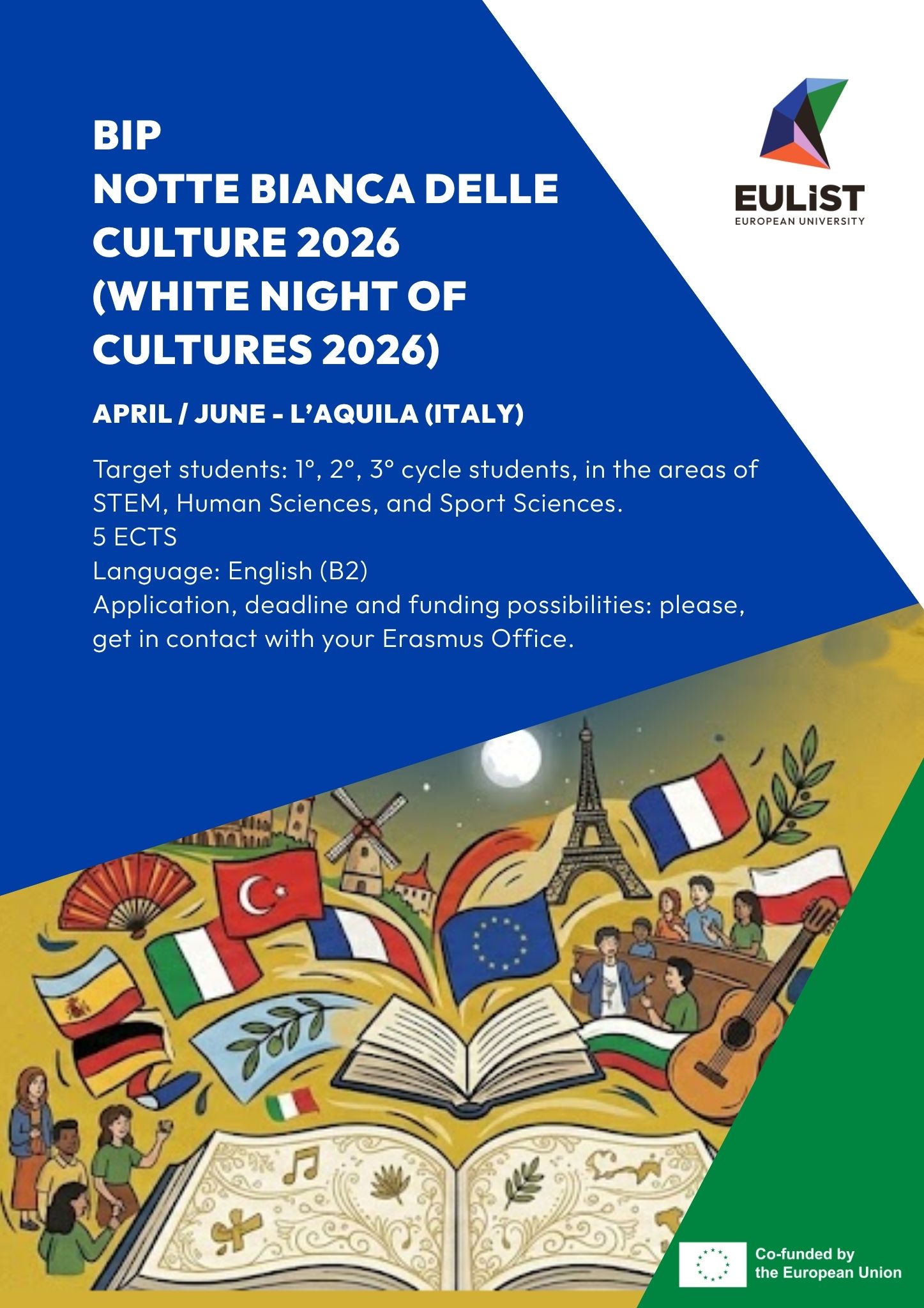
The University of L’Aquila, in cooperation with Leibniz Universität Hannover (LUH), Universidad Rey Juan Carlos (URJC) and Jönköping University (JU), is organizing a EULiST BIP called “Notte bianca delle culture 2026″ (White night of cultures 2026), in the framework of the “L’AQUILA, ITALIAN CAPITAL OF CULTURE 2026” event.
The programme will take place with online sessions (12 hours between April 20th and May 30th 2026), and in-person activities from June 2nd to June 7th 2026, in L’Aquila.
Type of participants/Target group: 1°, 2°, 3° cycle students, in the areas of STEM, Human Sciences, and Sport Sciences.
Objectives and description: The program focuses on the intersection between global citizenship, sustainability, and intercultural dialogue. The central theme is the transformation of academic knowledge (scientific and humanistic) into a tool for social cohesion. Through a multidisciplinary approach, the project explores how understanding cultural differences and adopting the Sustainable Development Goals (SDGs) can foster a shared European identity. The program uses the city of L’Aquila, Italian Capital of Culture for the year 2026, as an open-air laboratory for the integration of academic research and the local area.
Three main relevant areas are involved: scientific, humanistic, and sporting, thus involving three different departments of the University of L’Aquila: Human Sciences, Engineering and Information Sciences, and Mathematics and Applied Clinical and Biotechnological Sciences.
The training program aims to develop cross-cutting skills through three main phases:
- Virtual phase (preparatory): online meetings dedicated to the transfer of theoretical knowledge on global citizenship and intercultural approach. Students begin to collaborate in international teams to define the content of their research.
- Physical mobility phase (implementation): 5-days in L’Aquila focused on “Public Engagement.” Activities include science communication and storytelling sessions, team building activities, visits to local cultural heritage sites, and urban trekking.
- Final Event (06/06/2026): design and operational management of the “Night of Cultures,” a public dissemination event where participants present their work (monographic stories, comparisons between traditions, national monuments) to the local community.
Number of ECTS: 5
Application, deadline and nomination procedure:
Interested students should contact their university’s Erasmus office and EULiST local coordinator for more institution-specific information such as different application deadlines due to internal procedures. The selections will be carried out by the students’ home institutions.